A Note about Styles and Lineage
I began training in the Hung Gar and Choy Li Fut systems with Vernon Rieta back in 1991. His teacher was Buck Sam Kong, who learned his Hung Gar from Lam Cho, successor to Lam Sai Wing, heir to the legendary Wong Fei Hung. Buck learned Choy Li Fut from his close friend Lee Koon Hung. Throughout the years, I've also had the good fortune to learn from many other Hung Gar luminaries, including Y.C. Wong in San Francisco.
The Hung Gar style is also known as Tiger-Crane style. It is reknowned for its low, strong stances and short, sharp techniques. The more advanced forms incorporate increasingly greater amounts of chi gung training. The style combines the strength and aggression of the tiger with the softness and subtlety of the crane.
The Choy Li Fut style combines the short-range techniques common to southern styles with the long-fist techniques characteristic of northern styles. It emphasizes both leopard strikes and long circular full-arm attacks.
Both are considered "external" or "hard" styles, and both have their roots in the legendary shaolin temple. Taken together, the two styles provide an impressive variety of tactics for mid- and close-range fighting.
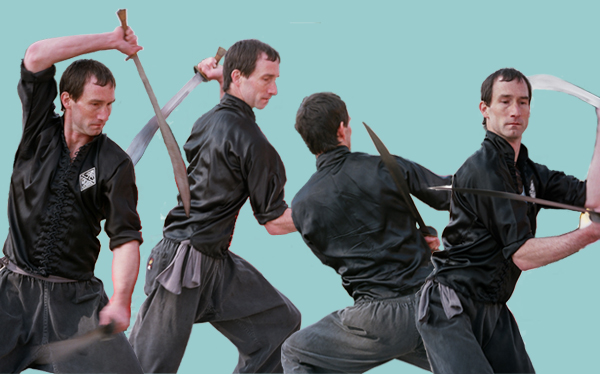
While emphasizing empty-hand techniques, Hung Gar also incorporates weapon training, most notably the single- and double-ended staff and short butterfly knives. Other important weapons include the Kwan dao, the double broadswords, and the tigerfork. Choy Li Fut is perhaps more closely associated with the more conventional battlefield weapons, the spear and broadsword.