The Cross Pattern in Choy Li Fut
I was practicing the Ping Kuen (Level Fist) form not long ago—as I've done for years and years—when I had a little revelation. When I learned the set, I noticed that there were sections in which the left foot never moved, and I thought that was pretty cool. But I suddenly realized it was not just isolated sections but the majority of the form. So I took a closer look, and picked it apart move by move. When I got rid of the shuffles and half steps and flashy acrobatics, it was clear that the left foot never left its spot, other than for the occasional unicorn step (kei lun bo).
I wondered if other forms followed the same pattern. Ping Jaang (Level Elbow) seemed like an obvious place to start, as it had some commonalities both in name and movements. Once again, when I cleaned up the footwork, the left foot stayed mostly planted in one spot. If it did move away, it moved right back. Interestingly, the form seemed to move a lot faster and feel more natural.
I could see excellent reasons for this. For starters, Choy Li Fut is known for its focus on defending against multiple attackers. If that's the case, you wouldn't want to venture off into the mob—you'd want to defend a small patch of ground, deflecting any attacks that came within it, from any side. And if no one entered your circle, you'd have no reason to fight (very Taoist!). Second: if you were with a group of fighters, you could space yourselves out, like pieces on a checkerboard, and not worry that you would interfere with each other. Third, kung fu schools were associated—rightly or wrongly—with anti-government (anti-Ching) sentiment, so many chose to train indoors, away from prying eyes. I've been to Lam Cho's studio in Hong Kong, and I can tell you there was not much room to move—only one student could practice at a time. I'm sure conditions were no better a few hundred years ago. Confining your forms to a small area was probably a practical necessity. In fact, I've heard stories of how students would practice in the intersection of two corridors—in the center of a crossway.
I asked myself: what other forms started the same way? Siu Moi Fah (Plum-Flower). But that was the first Choy Li Fut form I ever learned—surely that was sacred? Apparently not. Once again, when I took out the shuffles and uncertain transitions, I was 90 percent there. Some of what remained turned out to be things that had always bothered me. For example, after a sweep, why would you step into the person you just swept? Wouldn't that leave you both tangled up? Seems you would want to step away and free yourself. Addressing these issues, I once again found that the left foot stays firmly in place.
By examining—and modifying—these three basic forms, I started to develop a small set of simple rules that should apply to every form. I discovered that the forms were not at all haphazard, but that each move has a limited set of moves that can follow.
For example, after sinking into a horse stance with a vertical righthand chap choy, only two moves are allowed: either retreat by crossing in front with the right foot into a cross stance, or twist into a cross stance and then into the unicorn step. After a sweep, step away—not into—your opponent. And unlike Hung Gar, which tries to be balanced, Choy Li Fut assumes that you're right handed, and performs many moves exclusively with the dominant right hand or leg.
It also became clear that these forms all follow the same pattern. For those who remember analog clocks: start facing 12:00, then turn to 3:00, then 9:00, then 6:00, and return to 12:00 to finish. Or: face north to start, turn to the east, turn to the west, turn to the south, and turn back to north to finish.
I thought about other forms. Sap Ji Kau Da, the Cross-Pattern fist? Well, "Cross-Pattern" should've been the obvious giveaway. A cross has a point where the two lines intersect, and that's where the left foot stays. Tuet Jin has a similar opening—and when applying these basic rules, the name (Breaking Holds) makes a whole lot more sense, as you don't need to dance around to break free from a grab.
It goes without saying, but these are instructional forms—they focus on a few techniques, which are repeated (typically three times in different directions). If a form is too diverse, something has been added, and something has probably been dropped. The critical element is to view all these forms as part of a larger whole, rather than self-contained lessons. They culminate in the Sup Ji Kau Da, which is sort of the Reader's Digest condensed version of the style; it mostly strings together sequences from the other sets.
After (or in addition) to this curriculum come the animal sets. Do they follow suit? Yes and no. Let's start with Hok Ying, the crane set. Everyone seems to do it a bit differently—but if you boil it down to what they all have in common, then yes, the left foot stays in place. On the other hand, the version I learned does not follow a cross pattern—it mostly just goes forward and backward. I also do a dragon set—and to be honest, I wasn't sure that it was a Choy Li Fut form when I learned it. But when I examined it again, I saw that it too keeps the left foot in place (so I've decided it is indeed in the Choy Li Fut lineage).
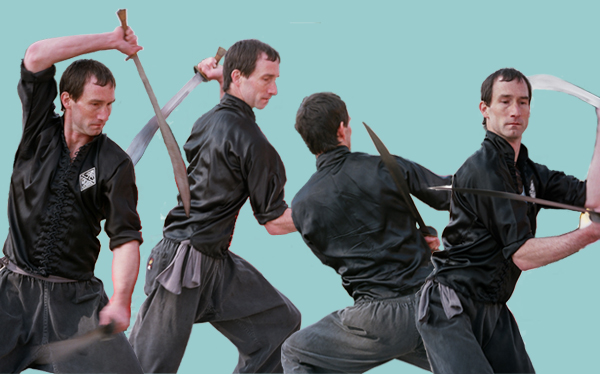
Weapons? Here it gets trickier. Many of them—spear, staff, darn dao, kwan dao—start by keeping the left foot in place, but then start to jump around. It's possible that they originally followed the pattern, but evolved into something more flashy. It's also possible that weapons were adopted from other styles and then modified to suit the Choy Li Fut way of doing things. On the other hand, the Sheung Lung Dao (Double Dragon Blades) largely follows the pattern. I learned this from the Hung Gar lineage, but edged weapons are a relatively new addition to Hung Gar, and I've seen Choy Li Fut schools do this form as well, so maybe that's where it originated.
You may argue that those shuffles, jumps, and angles make the movements more practical, more suited to a situation that does not play by any rules. To that I say: fair point. Ultimately, you must make each form your own, and to that end, perhaps it doesn't matter whether you adapt to the form or make the form adapt to you. Put another way, what's important is not how you move in the form, but how the form moves in you.
As for me, I get a sense of satisfaction in seeing the logic behind the moves, the rules that govern the actions. When you view all the forms as a cohesive unit, rather than a collection of disparate routines, you gain a better appreciation for the style overall. It's a bit humbling.
My sifu Vernon used to say: "The most important thing I can teach you is how to teach yourself." He'd also say: "Everything you need is in the forms." I've come to see the truth in those statements.
I also think it's pretty cool that even after all these years, I'm still finding more to learn.
And if you're curious, you can check out my "reformed" forms here: